

If you’ve been blogging on WordPress for years, you already know traffic isn’t always what it seems. Early in my blogging journey, I used to celebrate traffic spikes.
Over time, I realized many of those “visitors” were just bots like scraping content, hitting login pages, and quietly draining server resources.
Today in 2026, bot traffic is more aggressive, more intelligent, and in many cases, harder to detect. If you’re not actively managing it, it’s affecting your SEO, performance, and even your revenue.
In this blog post, I’ll show you how to properly block bad bots in WordPress using a mix of practical and advanced methods. Let’s start from the basics.
Disclosure: We get a commission when you buy a product via our affiliate link at no additional cost.
Table Of Contents

Bots are bad! Why? They don’t just waste bandwidth; they create compounding problems across your entire site. When they aggressively crawl your pages, your server has to respond to each request.
Over time, this increases CPU usage and slows down response times. Even a slight delay can affect Core Web Vitals, which directly impacts rankings.
Another issue is crawl budget. Search engines allocate limited resources to crawl your site. If bots are flooding your server, important pages may not get crawled efficiently.
Analytics distortion is another silent killer. When bot traffic inflates your sessions, your data becomes unreliable. You might make wrong decisions about content, SEO, or marketing because the numbers are misleading.
Bad bots can also harm your website by,
- Stealing data: Some bots scrape sensitive information like user details, and may leak it if your site isn’t secure.
- Injecting spam content: They can alter your content and replace it with spam.
- Posting spam comments: Automated comments can annoy users and damage your site’s reputation.
- Triggering cyberattacks: Advanced bots can attempt brute-force attacks or exploit vulnerabilities.
Because of this, managing bot traffic is essential. But you should not block everything. Focus on stopping bad bots while allowing legitimate ones like search engine crawlers.
Why Bot Traffic Has Increased in 2026?
Bot activity has increased in recent years, and it is due to the rise of AI crawlers. These bots are not just indexing content; they are collecting it for training machine learning models.
It has created a new wave of scraping at a scale we haven’t seen before. At the same time, automated hacking tools have become more accessible.
Even low-skill attackers can now run scripts that scan thousands of WordPress sites for vulnerabilities. Whether you’re running a small WordPress blog or a large WooCommerce store, your site will be affected by bot traffic.
How To Detect Bad Bots In WordPress?
Most bloggers rely only on Google Analytics, which is a mistake. To properly identify bot traffic, you need to look deeper!
- Server logs are one of the most reliable sources. They show actual requests hitting your server, which include user agents and IP addresses. If you notice repeated hits from the same agent within seconds, it’s a bot activity.
- WordPress Security plugins can help by logging blocked attempts, login failures, and suspicious behavior. Regular log check gives you a better understanding of what’s happening behind the scenes.
- Hosting dashboard metrics are another useful indicator. Sudden spikes in CPU usage or bandwidth without a matching increase in real visitors indicate the bot traffic.
How To Block Bad Bots In WordPress?
Though WordPress also offers bot protection services, there are many other tools and websites that you can use to block bad bots. Let’s look at every possible solution to block bad bots in WordPress.
1. Use Bot Protection in Cloudways
Note – As I use Cloudways hosting, I’m explaining this method. If you use other hosting, skip this point and move to the next.
Besides offering hosting services, Cloudways also allows you to protect your site from unwanted bots. Just activate the bot protection feature of Cloudways and eliminate the bots.
Why Use Cloudways Bot?
Cloudways bot protection allows you to whitelist the good bots that might not harm your site. Some other features of Cloudways bot protection are as follows.
Protection Against DDoS Attacks – The bot protection provides you with complete information on the traffic to your website, including their IP addresses. It blocks them immediately whenever you notice a sudden rise in traffic from unknown sources. It will prevent your site from crashing.
Protection Against Brute Force Attacks – It monitors all the login attempts and traffic to your website and stores data like the IP address and username. It places failed login attempts in a separate category, successively, so you can see if they are bots or real users.
How To Enable Bot Protection In Cloudways?
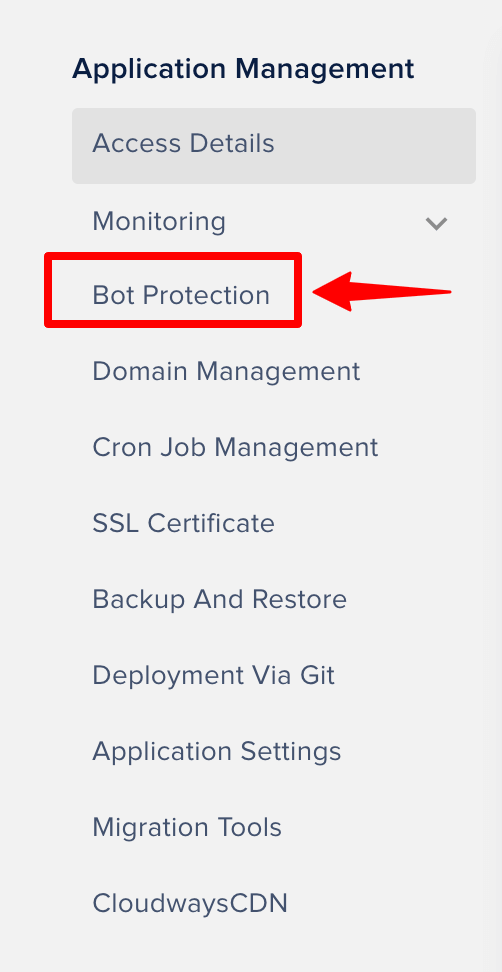
Go to Applications > Select your App > Bot Protection
Click Bot Protection > Toggle on Active to enable the bot
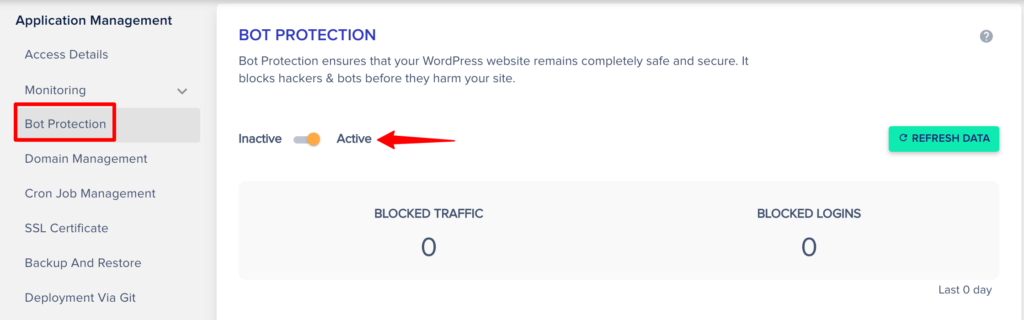
Now you can see the bad bots in the traffic and block them while whitelisting the legitimate ones.
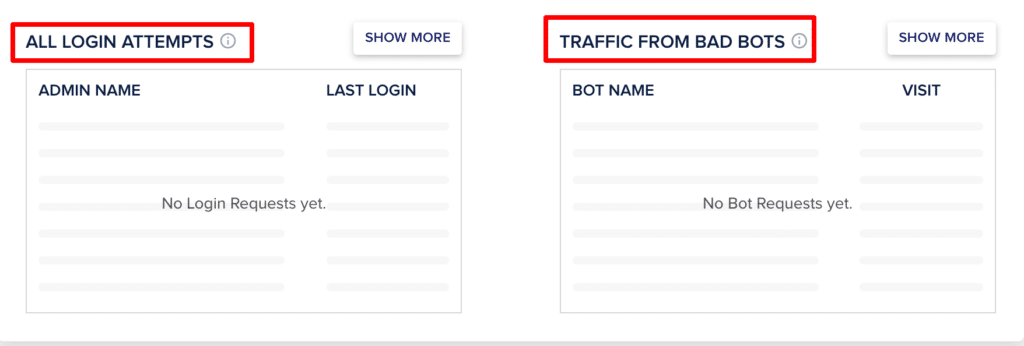
In Cloudways bot protection, we have a useful feature called All Login Attempts that displays recent logins, so you feel more secure.
Likewise, the Traffic From Bad Bots section filters all your bad bot traffic. You may check the blocked traffic and whitelist the genuine ones.
Note – If you have already installed the Malcare plugin before moving your site to Cloudways and want to enable the bot protection, deactivate it.
2. Use Cloudflare Bot Fight Mod
Next comes the Cloudflare bot flight mod that helps eliminate the bots you think are harmful to you. You need to observe the bot traffic coming to your website and point the suspicious ones among them. Then, you can block them by using the Cloudflare firewall.
Cloudflare offers two plans for bot protection. One is the bot fight mod, and the other, which is a bit advanced, is the super bot fight mode. However, both methods require creating a rule to block bots, and here is how you do it.
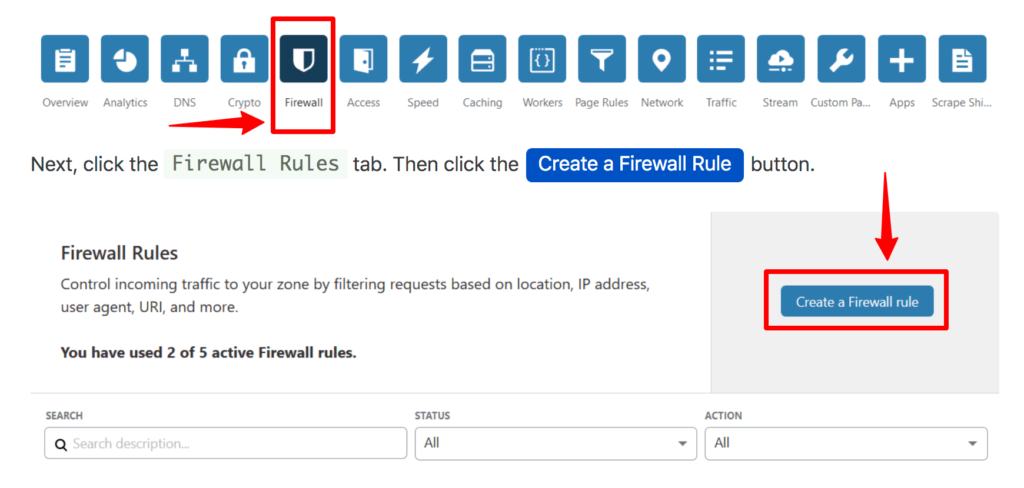
- After logging into Cloudflare, go to the firewall tab.
- Click on firewall rules, and you will see the rules that you have previously created.
- Click on the create rule button to create a new rule for new bots.
- Give your rule a name; you can set any name.
- Now, you have to enter the field, operator, and the name of the bot you want to block.
- You can block multiple bots in a single by using the “or” feature.
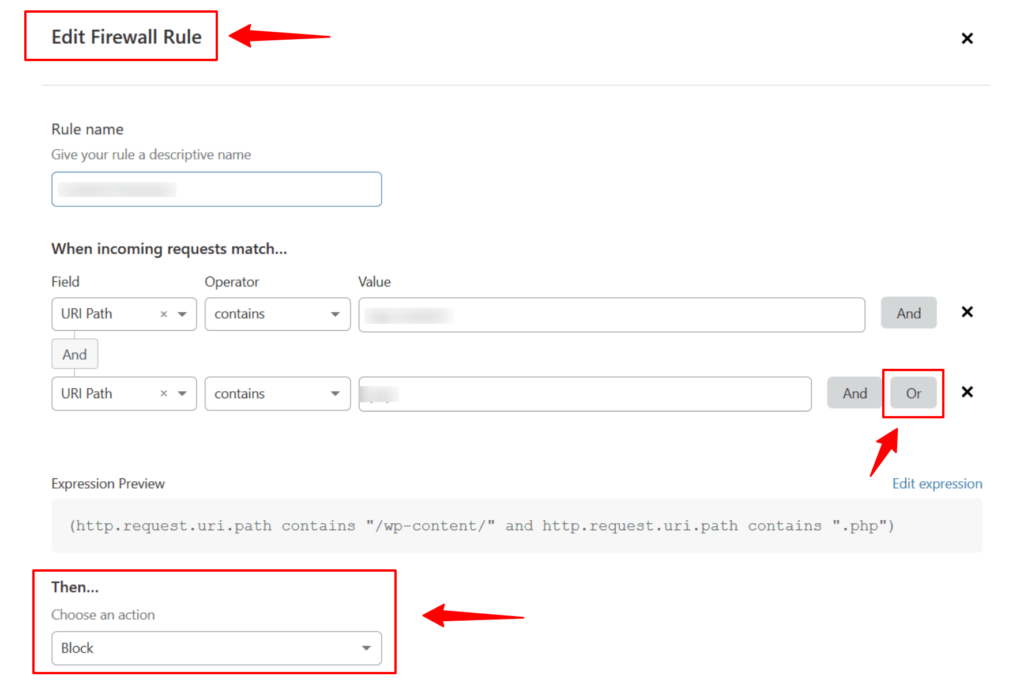
- It would be better if you wrote an expression for it.
- Now, select the option as a block and then deploy.
And this is how you do it. You can now see the bots blocked by Cloudflare.
3. Limit Login Attempts
To be honest, your website is always at risk as today’s hackers know several ways to creep through your website’s defense system. However, you can create a strong password to keep hackers and bad bots away.
Limiting login attempts is also a way to eliminate the bots and keep unwanted or unrecognized visitors away. Limiting login attempts to your website can be pretty simple with the “Limit Login Attempts Reloaded” plugin.
Customize Your Plugin
Go to the plugin’s settings to make customizations of your choice. Select the number of failed login attempts for one user.
After a user made specific failed login attempts, he would be blocked from trying again for some time. You can also customize the time before the user is blocked after several failed attempts.
4. Take Help From htaccess File
There is no end to the bad bots attacking your site. You block one, and the next day you have three more. So, it is better to stop a bad bot as soon as possible. The .htaccess file can also help you prevent your site from bad bots.
Though the .htaccess file can block most bots from accessing your website, it cannot recognize some bad bots. For such bots, you have to do some manual work. You have to identify the bot and create a blocking rule to block it. Here is an example of it.
RewriteEngine On
RewriteCond %{HTTP_USER_AGENT} (GPTBot|CCBot|Bytespider|AhrefsBot|SemrushBot) [NC]
RewriteRule .* - [F,L]
You can also block abusive IP ranges if you notice repeated attacks from specific regions. However, this should be done carefully to avoid blocking legitimate users.
5. Database and Backend Protection
Bots don’t just hit your front-end pages. They also target backend endpoints and targets,
- wp-login.php
- xmlrpc.php
- REST API endpoints
Disabling or restricting access to unnecessary endpoints can significantly reduce bot activity.
For example, if you’re not using XML-RPC, disabling it removes an entire attack surface. Similarly, limiting REST API access to authenticated users can prevent data scraping.
Blocking AI Bots Without Hurting SEO
This is a sensitive area and needs a balanced approach. AI bots are not search engines, but they still aggressively crawl your content. Blocking them won’t directly harm your rankings, but it can protect your intellectual property.
The safest approach is to start with robots.txt for basic control, then enforce rules at the server or firewall level for reliability. At the same time, always ensure that search engine bots are explicitly allowed.
Performance Gains After Blocking Bots
This is something many bloggers don’t measure, but should be doing. After implementing proper bot blocking, you may notice:
- Reduced server load
- Faster page load times
- Lower hosting costs
- Improved uptime during traffic spikes
In some cases, sites see dramatic improvements in Time to First Byte (TTFB), especially on shared hosting.
Final Thoughts
Blocking bad bots in WordPress is no longer just a security task; it’s a core part of technical SEO. As bot activity increases, especially from AI crawlers and automated scripts, ignoring this issue can quietly hold your site back.
The goal is not to block everything, but to block intelligently. When you combine plugin-level protection, server-level rules, and network-level filtering, you create a system that is both efficient and future-proof.
And once you implement it properly, you’ll not only protect your site, you’ll also create a faster, cleaner, and more reliable experience for real users.
Blocking bots is not a one-time task; once you implement a suitable method, you should regularly review server logs, plugin reports, and firewall activity. Keep your rules up to date to ensure long-term protection.



Hey there!
Useful Post, you always have good humor in your posts/blogs. So much fun and easy to read! And for the record, we are still at it on the Flash reading.