

If you want to justify text in WordPress, you may have noticed that the justify button is missing in the modern Gutenberg block editor. Many beginners assume the feature was removed completely, but there are still several easy ways to align text evenly on both sides in WordPress.
I have been using the WordPress CMS for my business websites for over a decade. I’m greatly missing an adorable feature, “Justify,” in its latest block editor. Yes, WordPress 4.7 has taken off the “Justify” button in 2016 as it has uneven browser implementation and affects the text readability.
Even though this exceptional text alignment feature has disappeared from the Gutenberg editor, it has been loved by many WordPress users like me. So, if you are the one who wants to pull back this “Centered Text With Margin” feature to your recent version of WordPress, then you might have the following questions in your mind!
How to justify text in Gutenberg WordPress?
How do I center the text in WordPress?
How to center a block in WordPress?
How do I align text in WordPress?
And much more about the text alignment with the margin!
In this tutorial, I’ll show you how to justify text in WordPress using Gutenberg, custom CSS, plugins, and the Classic Editor. I’ve been working with WordPress for years and regularly publish WordPress tutorials. I’ve tested these methods on the latest WordPress versions, modern block themes, and mobile devices to ensure they work properly.
Table Of Contents
- What Does Justify Text Mean?
- Why Did WordPress Remove the Justify Button?
- Should You Use Justified Text in WordPress?
- Method 1: Justify Text in WordPress Using Custom CSS
- How to Justify Only Specific Paragraphs?
- Method 2: Justify Text in Gutenberg Without a Plugin
- Method 3: Use a Plugin to Add Justify Text in WordPress
- Method 4: Justify Text in the Classic Editor
- How to Justify Text in Elementor?
- Common Problems With Justified Text
- Best Practices for WordPress Text Alignment
What Does Justify Text Mean?
Justified text aligns both the left and right edges of a paragraph evenly. Instead of a ragged right edge, WordPress adjusts word spacing so each line forms a clean block of text.
This type of paragraph alignment is commonly used in Newspapers, Magazines, eBooks, Academic documents and Printed publications. Many website owners also use justified text to create a cleaner visual layout.
Older versions of WordPress included a justify text button in the editor toolbar. However, the WordPress team removed it from the Gutenberg block editor because justified text can reduce readability on smaller screens.
On mobile devices, justified paragraphs can create:
- Uneven word spacing
- Large gaps between words
- “Rivers of white space”
- Poor reading experience
This is one reason why modern web typography usually prefers left-aligned text instead of justified text. Still, if used carefully, justified text in WordPress can look great for certain layouts and designs.
Should You Use Justified Text in WordPress?
Before enabling text justification, you should understand its pros and cons!
Advantages
- Creates a clean and symmetrical layout
- Works well for magazines and editorial sites
- Gives content a professional print-style appearance
Disadvantages
- Can hurt readability on mobile screens
- Creates uneven spacing between words
- May negatively affect accessibility for some users
In my experience testing justified text across different WordPress themes like Astra, Kadence, and GeneratePress, it works best for:
- Wide desktop layouts
- Magazine-style designs
- Short paragraphs
- Multi-column content sections
For regular blog posts, left-aligned text is usually easier to read.
Method 1: Justify Text in WordPress Using Custom CSS
This is the best and most lightweight method because it works without installing a plugin.
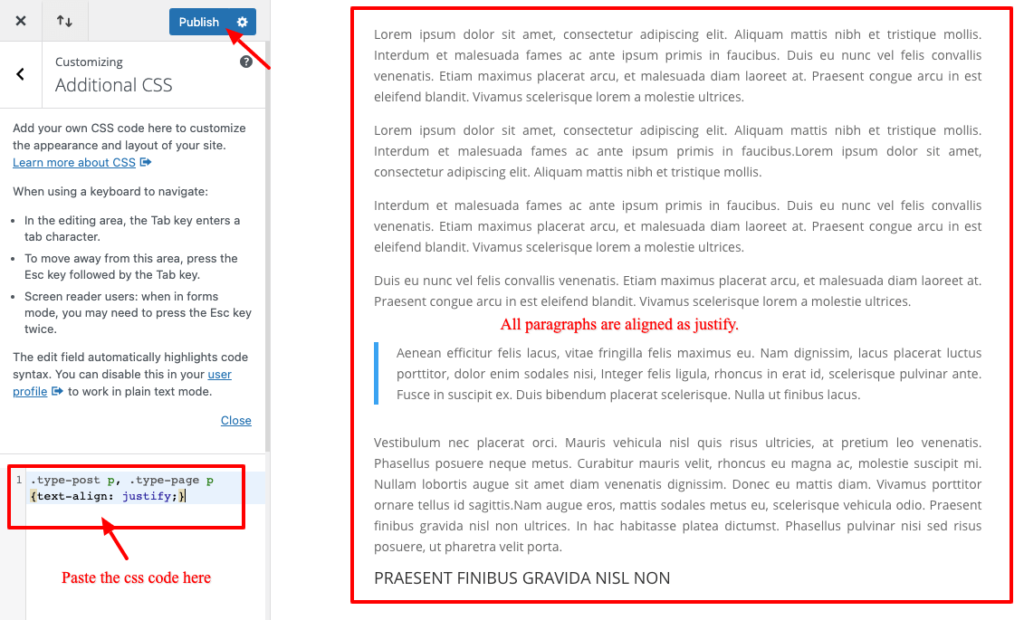
Step 1: Open the WordPress Customizer
Go to: Appearance → Customize → Additional CSS
Step 2: Add This CSS Code
p {

    text-align: justify;

}
Step 3: Publish Changes
Click the Publish button. Your paragraph text will now be justified throughout your WordPress website.
How to Justify Only Specific Paragraphs?
Instead of applying justified text sitewide, you can justify only selected content areas.
Add this CSS code
.justify-text {

    text-align: justify;

}
Now open a paragraph block in Gutenberg.
Under: Block → Advanced → Additional CSS Class
Add: justify-text
This method gives you much better control over WordPress text alignment.
Why I Prefer the CSS Method?
As a WordPress user and tutorial writer, I usually recommend the CSS approach because:
- No extra plugin is required
- Faster website performance
- Cleaner setup
- Works with most themes
- Easy to customize
It’s also future-proof compared to relying on editor plugins.
Method 2: Justify Text in Gutenberg Without a Plugin
You can also justify text directly inside the WordPress block editor using custom HTML.
Step 1: Select the Paragraph Block
Open your post or page inside Gutenberg.
Step 2: Open the Block Options
Click the three-dot menu in the toolbar.
Choose: Edit as HTML
Step 3: Add Inline CSS
Wrap your paragraph like this:
<p style="text-align: justify;">

Your content.

</p>
Step 4: Preview the Content
Switch back to visual editing and preview the page. This method is useful if you only want to justify one paragraph in WordPress.
Method 3: Use a Plugin to Add Justify Text in WordPress
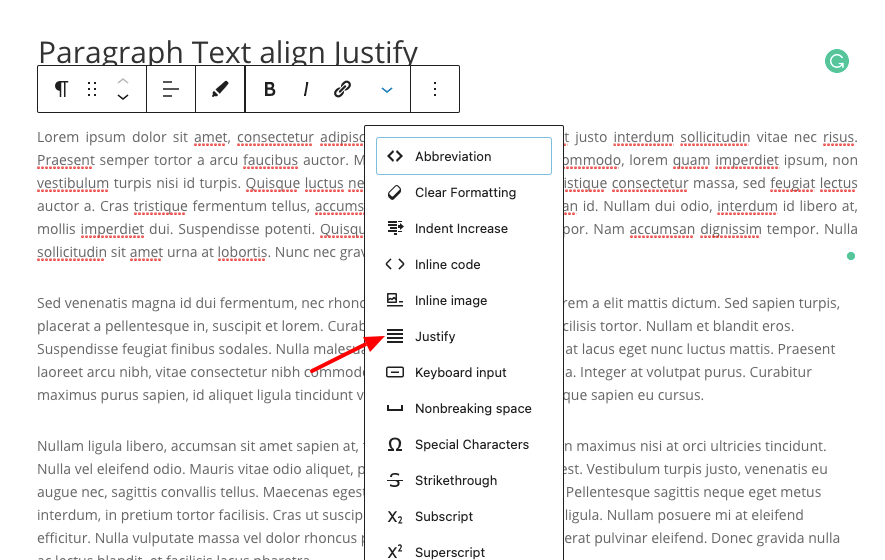
If you prefer a visual editor option, you can use a plugin to restore justify text controls.
Option 1: EditorsKit
EditorsKit adds additional formatting tools to the Gutenberg editor, including support for justified text.
It’s useful if you frequently work with:
- Custom formatting
- Editorial layouts
- Advanced Gutenberg controls
Option 2: Advanced Editor Tools
Advanced Editor Tools (formerly TinyMCE Advanced) is another popular plugin for restoring formatting options in the Classic Editor and Gutenberg.
It provides:
- Additional toolbar buttons
- Better formatting controls
- More text alignment options
Which Plugin Should You Use?
In my testing, EditorsKit feels more modern for Gutenberg users, while Advanced Editor Tools is better for websites still using the Classic Editor.
However, I still recommend the CSS method whenever possible because plugins add extra code and maintenance overhead.
Method 4: Justify Text in the Classic Editor
If you still use the Classic Editor plugin, adding justified text is very easy.
Option 1: Keyboard Shortcut
Select your text and press:
- Alt + Shift + J (Windows)
- Control + Option + J (Mac)
If the justify button is missing:
- Install Advanced Editor Tools
- Enable the justify alignment button
- Save changes
You can now justify paragraphs directly inside the editor toolbar.
How to Justify Text in Elementor?
Many WordPress users want to justify text in Elementor.
Here’s how:
- Open the Text Editor widget
- Go to the Style tab
- Add this CSS:
selector {

    text-align: justify;

}
This will justify text inside the Elementor widget.
Common Problems With Justified Text
1. Large Gaps Between Words
This happens mostly on narrow screens or mobile devices.
Solution
Use shorter paragraphs and avoid justification on very small text containers.
2. Justified Text Looks Uneven
Some fonts handle justification poorly.
Recommended Fonts
- Roboto
- Open Sans
- Lora
- Merriweather
3. Mobile Readability Issues
Justified text may reduce readability for mobile users.
Solution
Disable justification on smaller screens using responsive CSS:
@media (max-width: 768px) {

    p {

        text-align: left;

    }

}
Best Practices for WordPress Text Alignment
Here are some typography best practices I personally follow when designing WordPress websites:
1. Use Justification Sparingly
Avoid justifying every paragraph on your website.
2. Test on Mobile Devices
Always preview your content on:
- Smartphones
- Tablets
- Different browsers
3. Combine With Good Typography
Use:
- Proper line height
- Readable font sizes
- Wide content containers
- Quality fonts
4. Focus on Readability First
A visually perfect layout means nothing if visitors struggle to read the content.
WordPress Justify – Video Tutorial
If you don’t have time or are bored with reading the content, here is a video tutorial on how to use the Justify feature in WordPress.
Frequently Asked Questions
Can I justify text without a plugin?
Yes. The easiest method is adding: text-align: justify using this Additional CSS.
Is justified text bad for SEO?
No. Justified text does not directly affect SEO. However, poor readability and user experience can indirectly affect engagement metrics.
Does justified text affect mobile users?
Yes. On smaller screens, justified text may create awkward word spacing and reduce readability.
Wrapping Up
The paragraph text alignment on the web page plays an important role in the readability and diversity of the web page. Justify increases the space between the words and neatly aligns the text on the left and right edges. This tidiness gives your website a professional look.
Although WordPress removed the justify button from the block editor, there are still several easy ways to justify text in WordPress. For most users, I recommend using custom CSS because it’s lightweight, flexible, and works with modern WordPress themes and block editors.
If you prefer visual editing tools, plugins like EditorsKit and Advanced Editor Tools can also help restore justify text functionality. Just remember to prioritize readability and mobile responsiveness before applying justified text across your entire website.



Got some help from this article. Thanks
Thanks for sharing this information.
Nice Post keep it up
very thanks working just easy without plugin……