

Over the years, I have managed several WordPress websites across different niches. One performance issue I repeatedly encounter is a slow database.
When a WordPress site grows with more content, plugins, and user interactions, the database gradually accumulates unnecessary data. This eventually affects website speed and server performance.
I started blogging in 2010 and have worked with WordPress for more than a decade. From my experience, database optimization is one of the most overlooked yet powerful performance improvements you can make.
In this guide, I will share practical methods I personally use to optimize WordPress databases and keep your sites running efficiently.
Disclosure: We get a commission when you buy a product via our affiliate link at no additional cost.
Table Of Contents
- What Is WordPress Database Optimization?
- How WordPress Stores Website Data?
- Signs Your WordPress Database Needs Optimization
- Prepare for Database Optimization
- Optimizing the WordPress Database Using Plugins
- Manual Database Optimization
- Combining Database Optimization With Frontend Optimization
- Database Optimization Results: A Real Example
What Is WordPress Database Optimization?
WordPress database optimization is the process of cleaning unnecessary data and improving database efficiency so that WordPress can retrieve information faster.
Over time, WordPress stores large amounts of temporary or redundant data, such as revisions, spam comments, and expired transients.
When this data accumulates, database queries become slower and your website will take longer to load pages. If you optimize the database, it helps to:
- Reduce database size
- improve query performance
- Decrease server response time
- Enhance overall website speed
In many cases, cleaning a bloated database alone can noticeably improve site performance. Let me tell you how WordPress saves your site data!
How WordPress Stores Website Data?
Every WordPress website runs on a MySQL database that stores all content and configuration settings. Each type of data is stored in specific database tables.
Some of the most important WordPress tables include:
1. wp_posts – This table stores posts, pages, attachments, and revisions. Whenever you create or edit content, new entries are stored here.
2. wp_postmeta – This table contains metadata associated with posts. It often becomes the largest table on many websites because plugins store additional information here.
3. wp_options – The options table stores important configuration settings including plugin settings, theme options, and cached data.
4. wp_comments – All comments submitted on your website are stored in this table.
5. wp_users – User accounts and login information are stored here.
Understanding these tables helps identify where database bloat usually occurs.
Signs Your WordPress Database Needs Optimization
After working with multiple WordPress websites, I recognized database issues through several warning signs. Your site needs database optimization if you notice:
- slow page loading even with caching enabled
- a sluggish WordPress admin dashboard
- high server response time (TTFB)
- a large number of post revisions
These issues typically appear gradually as your website grows.
Why WordPress Databases Become Bloated?
WordPress automatically stores various types of temporary data. While this is useful for functionality, it can create unnecessary database growth over time.
One of the biggest causes is post-revisions. Every time you update a post or page, WordPress saves another revision. After years of editing content, thousands of revisions will get accumulate.
Another common issue is auto drafts. These are temporary versions of posts that WordPress creates while you are editing content. Many of them remain unused in the database.
Spam comments also contribute to the database size. Even when filtered by spam protection plugins, they remain stored until manually removed.
In addition, WordPress and plugins store temporary cached data called transients. When these transients expire, some plugins fail to remove them properly, leaving unnecessary entries behind.
Finally, uninstalling plugins may leave behind unused tables or metadata, further increasing the database size.
Prepare for Database Optimization
Before you make changes to your database, it is important to take precautions. Database optimization is generally safe, but mistakes can cause data loss if proper backups are not available.
The first step is creating a full database backup. You may save the files either through your hosting service or by using a reliable backup plugin.
Once a backup is complete, it is useful to test your current website’s performance, and you can measure improvements later with GTmetrix or Google PageSpeed Insights.
These tools provide insights into page load time, server response time, and performance scores, so that you can test your site speed before and after optimizing your WordPress database.
Optimizing the WordPress Database Using Plugins
For most website owners, using a plugin is the easiest way to clean a WordPress database, as it can automatically remove unnecessary data and optimize database tables.
I recommend two plugins: WP-Optimize and WP-Sweep.
1. WP Optimize
WP-Optimize plugin removes post revisions, clean spam comments, delete expired transients, and optimize database tables. It also allows scheduled database cleanups, so maintenance happens automatically.
You will find a list of pre-selected optimization options configured for your WordPress database. You will also see some options marked in red that you can select.
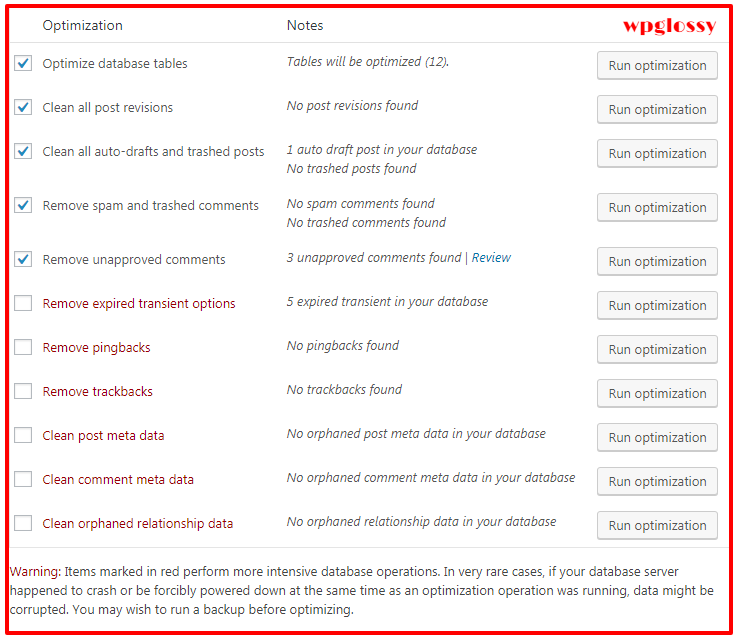
However, they are marked red for a reason. Optimizing or changing those tables can result in critical errors if not handled appropriately.
So, if you aren’t aware of those options, then I would advise you to leave them and run all the other optimizations suggested by the plugin.
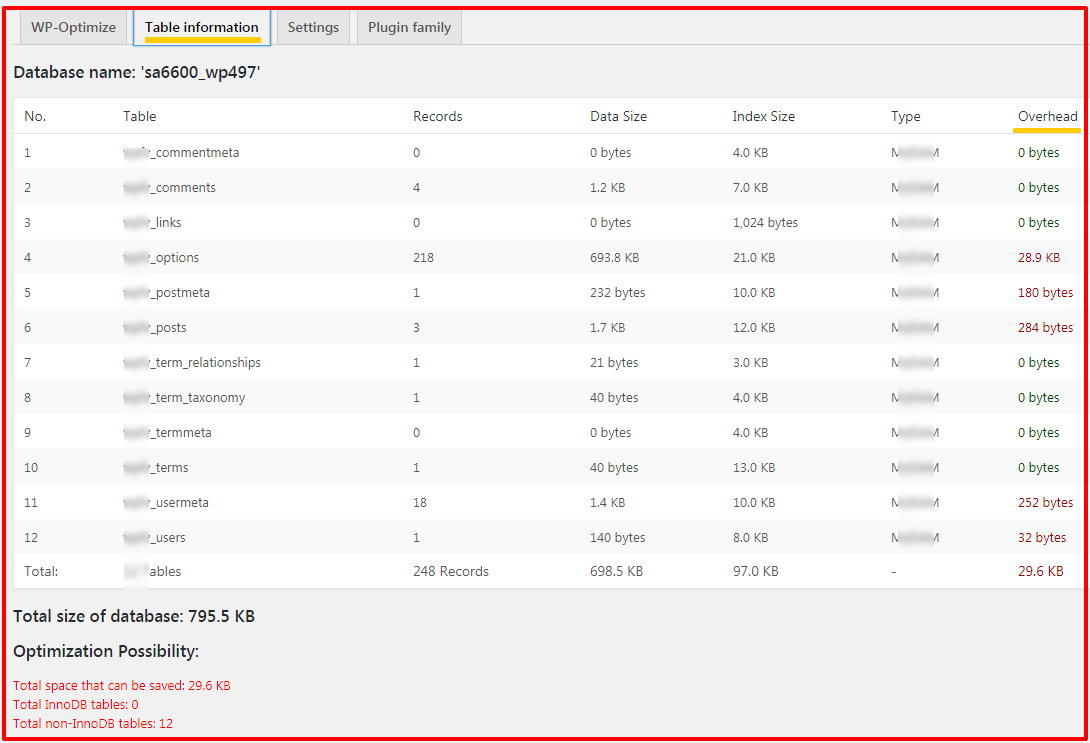
You can also visit the “Table Information” tab to check the list of tables on your WP database and analyze the load each table puts on your server.
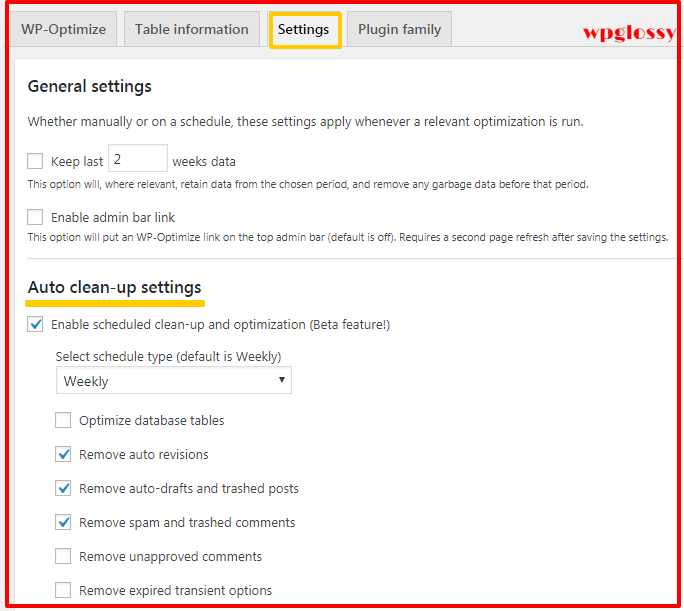
In the “Settings” tab, you will find options to schedule database repairs and other helpful options.
2. WP-Sweep
WP-Sweep will automatically analyze your WordPress database and show you the clutter that has accumulated over the years. The clutter sweep data is classified into sections such as Posts, Comments, Users, Term, and Options.
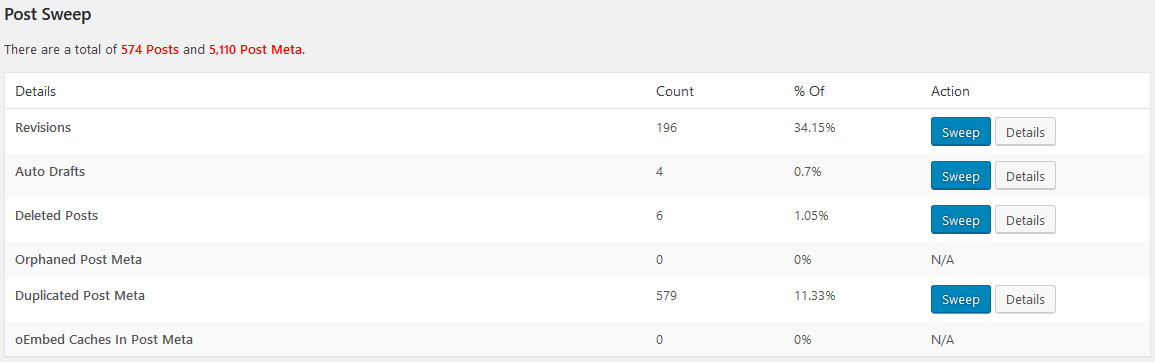
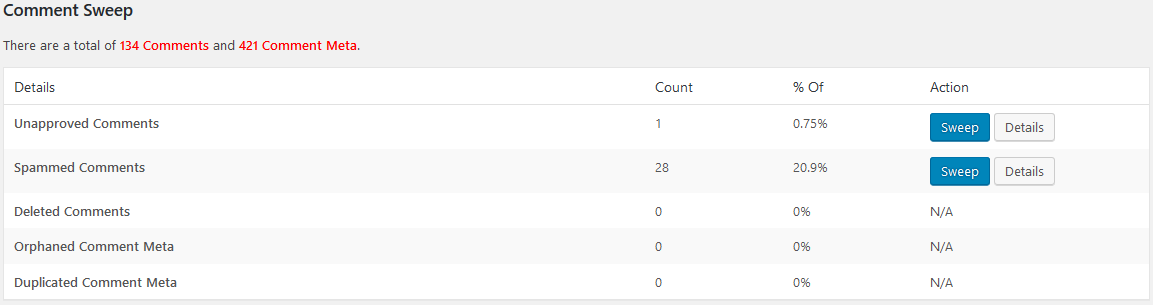
Once you have cleared every other section, you need to hit “Sweep” in the Database sweep section. This will fully optimize your WP database.

There’s also a button at the end to sweep all if you don’t want to clear the database from one section to another.
From my experience, running periodic cleanup with a database optimization plugin keeps the database size under control and prevents performance degradation over time.
Manual Database Optimization
Advanced users sometimes prefer manual database optimization through phpMyAdmin or command-line tools. This approach offers greater control but should only be used if you are comfortable working with databases.
How To Clean WordPress Database Through PhpMyAdmin?
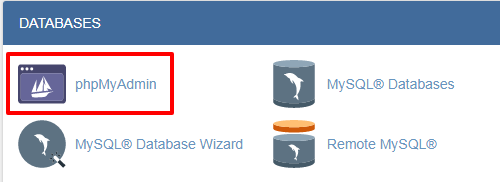
Go to your hosting CPanel > PhpMyAdmin
Click your database file, and now, you will see the tables as shown in the image below
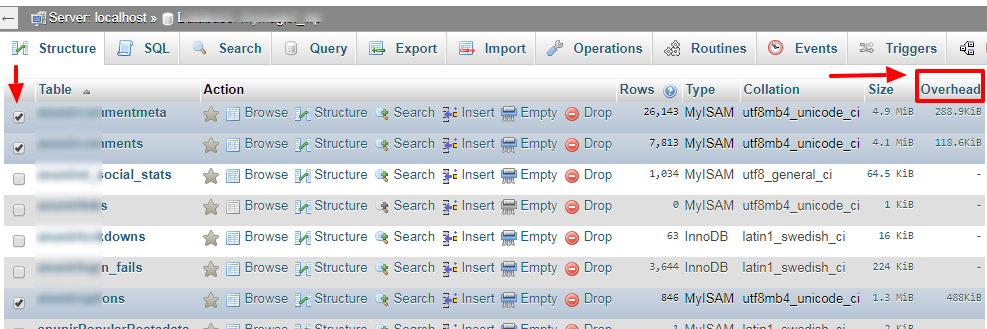
Scroll down and check the option “Check Tables Having Overload.”
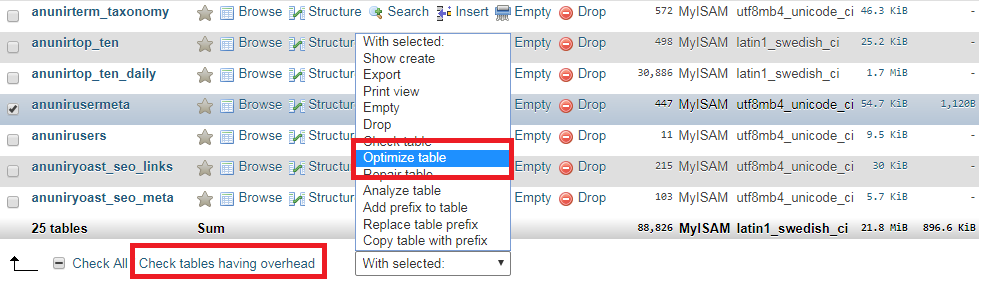
From the drop-down menu, choose “Optimize Tables” (Shown in the above image)
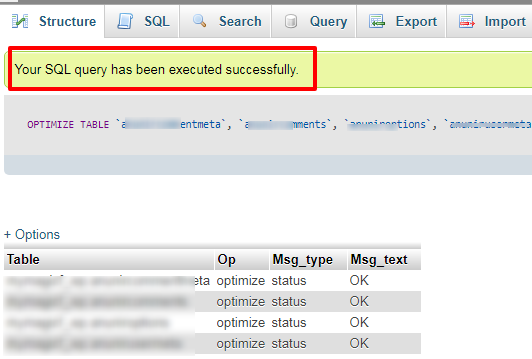
That’s it! You have optimized your WordPress database without using any plugin, and you will get a result message like the one below!
WordPress Database Cleanup Through SQL Command
You can remove post revisions with a simple SQL command:
DELETE FROM wp_posts WHERE post_type = 'revision';
After cleaning unnecessary data, database tables can also be optimized to remove overhead and improve performance.
Although manual optimization is powerful, it requires caution and proper backups.
Importance of Optimizing the wp_options Table
One of the most overlooked performance issues in WordPress involves the wp_options table.
This table contains settings and configuration values used by WordPress and installed plugins. Many of these entries are marked as autoload, which means WordPress loads them on every page request.
If the autoloaded data becomes too large, it can slow down the entire website because WordPress has to load excessive data for every visitor.
Cleaning unnecessary options and expired transients from this table often provides noticeable speed improvements.
Combining Database Optimization With Frontend Optimization
Database optimization improves backend performance, but frontend asset optimization is also important for overall site speed.
On many WordPress websites I manage, I also use Autoptimize as it focuses on optimizing static files rather than the database. It improves performance by minimizing and combining CSS, JavaScript, and HTML files.
The plugin helps by:
- Reducing file sizes
- Decreasing HTTP requests
- Optimizing CSS and JavaScript delivery
- Enabling lazy loading for images
In my experience, combining database optimization with frontend optimization tools like Autooptimize produces much better results than relying on a single performance technique.
Database Optimization Results: A Real Example
On one of my content websites, the database had grown significantly after years of publishing and editing articles.
Before database optimization:
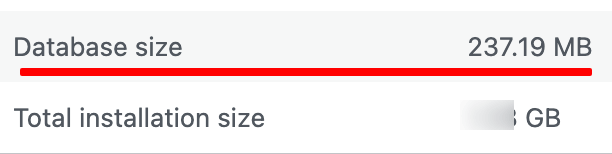

- Database size: 237.19MB
- Page load time: 2.2 seconds
- Average Requests: 34
After performing database cleanup and optimization:
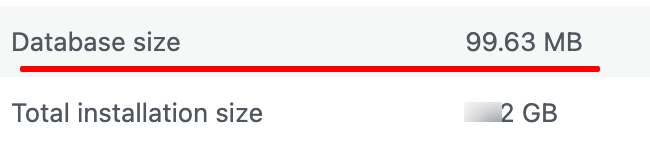

- Database size: 99.63MB
- Page load time: 1 second
- Average Requests: 30
Note: The improvement was noticeable even without changing the hosting or caching configurations.
Common Database Optimization Mistakes
While optimizing WordPress databases is beneficial, you should avoid these mistakes!
Some users attempt optimization without creating a backup, which can lead to data loss if something goes wrong. Others remove plugin tables without realizing that those tables are still required by active plugins.
Over-cleaning transient data can also create performance issues if cached information that WordPress relies on is removed unnecessarily.
Be careful and follow a methodical approach to prevent these problems!
Frequently Asked Questions
How often should I optimize my WordPress database?
For most websites, database optimization every one to three months is sufficient. Large websites or WooCommerce stores may benefit from monthly optimization.
Can database optimization improve website speed?
Yes. Cleaning unnecessary data reduces the workload on the database server that will allow WordPress to retrieve content faster.
What are WordPress transients?
Transients are temporary cached data stored in the WordPress database. They are used by WordPress and plugins to store temporary information for faster performance. When transients expire, they should be deleted automatically, but sometimes leftover entries remain in the database and require manual cleanup.
Can database cleanup break my website?
Database cleanup usually does not break a website if performed correctly. Problems may occur if important plugin tables or metadata are deleted accidentally. That is why I recommend that you perform cleanup carefully and always keep a recent backup before making database changes.
Final Thoughts
After managing WordPress websites for more than a decade, I have learned that performance optimization is not about a single solution. It involves maintaining multiple components of your site, including hosting, caching, frontend assets, and the database.
Database optimization is critical because every page request depends on database queries. When it becomes bloated, even the best hosting environment cannot compensate for slow queries.
By regularly cleaning revisions, removing unnecessary data, and combining database optimization with frontend tools like Autoptimize, you can maintain a fast and efficient WordPress website for the long term. So, are you ready for the database cleanup?



Hello Nirmala Mam,
I am also using WP Sweep Plugin to optimize and clean up my database. It is one of the best optimization plugin I have ever seen. It drastically free up your database with unwanted database tables and other orphaned database tables and post options. I highly recommend this plugin to everyone. Using it without any problem.
Have a great day 🙂
Vishwajeet
great post Nirmala….i will surely take note of this …never cleaned my blog database in past…this will really help in improving my blog speed….i will use plugins to clean the database..thanks for sharing this helpful information…thanks for sharing this post..!
Arvind
Hi Nirmala,
You’ve given some great information for sure.
I never thought of cleaning my database but you really make a good case for why it’s so important to do.
And the fact that you have recommended a great plugin to use to do the big part of the work … is a real bonus.
Very helpful for me and I will pass it on to my blogging students.
I know they’ll appreciate it too.
-Donna
Nirmala, my database size is grown to over 60MB now for a 3 year old blog with about 200 posts, I think I need to try WP-Sweep now. I have been using the WP Optimize but it has not brought the size down of my database.
Thanks for the prompt about WP Sweep, I am going to try it now. Cheers.
Ahmad
Hey Nirmala,
Whenever I speak at any event or a meetup, I always recommend people to optimize the database. It’s because aren’t really familiar with this concept.
Using the plugin like Wp-Optimize is good but I use WP-Sweep which is much better and responsive as compared to others.
Using the phpMyAdmin can freak people out. Not for the non-techie people.
Thanks for this informative article.
~Ravi
great post Nirmala….i will surely take note of this …never cleaned my blog database in past…this will really help in improving my blog speed….i will use plugins to clean the database..thanks for sharing this helpful information…thanks for sharing this post..!
Thanks, author for posting a detailed guide to optimizing the database. Wp-rocket also has an inbuilt option to clean and optimize the WordPress database. However, other plugins like wp clean are also good. Users should take the backup of their database before doing anything with the MySQL databases.
This will really help in improving my blog speed. This is a really good post. I appreciate your work.
It was such a great article which was on the wordpress database for better performance. Here, I would like to add some easy points in your blog which are as follows.
1.Delete Unused Data and Revisions
2.Optimize Database Tables
3.Limit Post Revisions
4.Reduce Autoloaded Data
5.Use a Caching Plugin
6.Disable Unnecessary Features
Hope, these points might help you. Readers, If you want to develop your wordpress website, you can visit an IT company like Alakmalak Technologies. They have an experienced team in this field.