

Are you worried about finding a solution to reduce high CPU usage in WordPress? You have come to the right place to overcome this common issue by implementing simple strategies.
When your WordPress site starts slowing down, showing 5xx errors, or your host warns about high CPU usage, it’s a clear signal that your website is consuming more server resources than it should.
As I’ve been working with WordPress since 2010, I’ve fixed dozens of cases where WordPress CPU usage hit 100%, and in most situations, the issue wasn’t traffic; it was due to inefficient configuration.
In this guide, I’ll walk you through how to reduce high CPU usage in WordPress, explain why it happens, and show you practical ways to lower server load without breaking your site.
It is essential to resolve this issue as quickly as possible. However, you need to know how and when the CPU is used heavily in WordPress sites to resolve the high memory usage efficiently.
Disclosure: We get a commission when you buy a product via our affiliate link at no additional cost.
Table Of Contents
- What causes high CPU usage in WordPress?
- How to Identify High CPU Usage in WordPress?
- Proven Ways To minimize CPU Usage in WordPress
- 1. Understand Your Hosting Limits
- 2. Optimize Your Database
- 3. Optimize The Images
- 4. Cron Jobs Control in Hosting Control Panel
- 4. Integrate CDN for Content delivery
- 5. Audit Your Plugins (Be Ruthless Here)
- 6. Use Caching the Right Way
- 7. Reduce Background Activity in WordPress
- 8. Block Unwanted Bots And Unwanted Traffic
What causes high CPU usage in WordPress?

To fix CPU issues properly, you need to understand how WordPress consumes resources. Every time a user visits your website, WordPress:
- Executes PHP scripts
- Queries the MySQL database
- Loads plugins and theme files
If any of these processes are inefficient or repeated unnecessarily, CPU usage increases rapidly.
For example, a poorly optimized plugin might run heavy database queries on every page load. Similarly, if caching is disabled, your server performs the same work for every visitor instead of serving a cached version.
Another major factor is external traffic and bots. Even if your real user traffic is low, automated bots can generate hundreds of requests per minute, pushing CPU usage to its limit.
These are the reasons for WordPress’s high CPU usage! So, let’s fix it with simple actions!
How to Identify High CPU Usage in WordPress?
One of the biggest mistakes site owners make is blindly applying fixes. Instead, you should first identify where the load is coming from.
Start with your hosting dashboard. Most panels show CPU usage graphs, memory usage, and entry processes. If you notice spikes during certain times, try to correlate them with traffic or scheduled tasks.
If you use Cloudways hosting, you can use the application performance monitoring to view server health, RAM, CPU, and disk usage for every WordPress application and extension.
You can monitor server and application status like this!
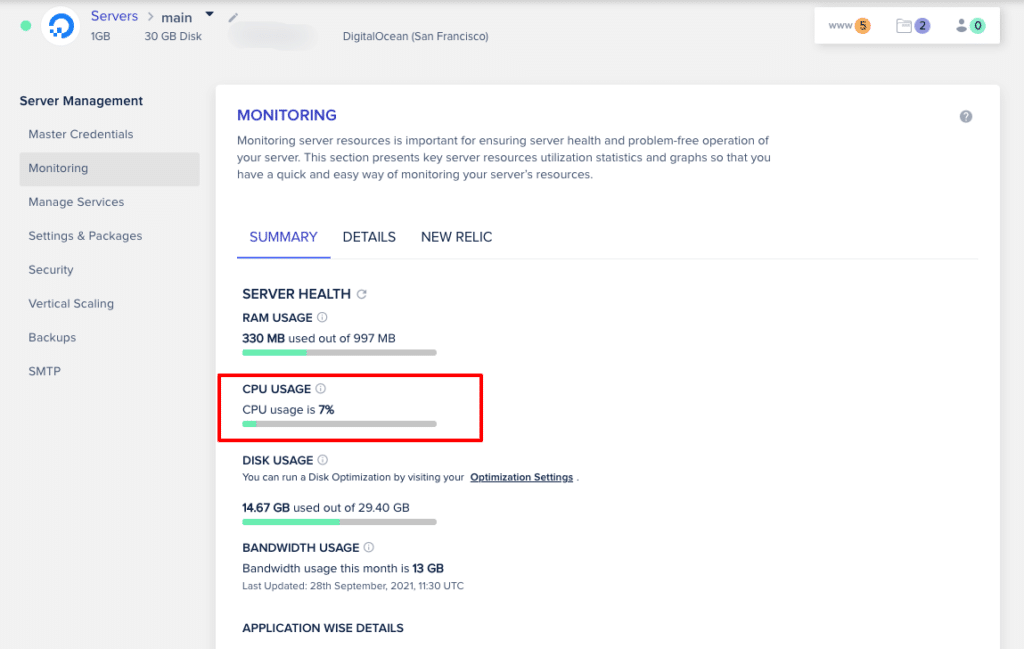
Application-wise CPU usage helps you find the right plugins and applications that minimize CPU usage and memory access in WordPress.
The API-integrated applications, such as eCommerce plugins, Page Builders, and Visual Composer, can also be monitored and removed if they exceed the CPU limit in the Cloudways application performance monitoring tool.
If you are not using Cloudways hosting, install Query Monitor. This plugin gives you a detailed breakdown of:
- Database queries and their execution time
- PHP errors and warnings
- Hooks and actions are triggered on each request
If a specific plugin is causing slow queries, you’ll see it immediately. In many real-world cases I’ve handled, bot traffic alone was responsible for more than 50% of CPU usage.
For deeper analysis, check access logs. These logs can reveal whether bots are repeatedly hitting endpoints such as /wp-login.php or /xmlrpc.php.
Proven Ways To minimize CPU Usage in WordPress
I have seen some website founders receive email notifications from their hosting provider about CPU usage, stating that most of their allowed usage has been used up and the service will be terminated once the limit is reached.
Let’s see some of the proven ways to troubleshoot this WordPress issue!
1. Understand Your Hosting Limits
Your hosting environment plays a huge role in CPU usage. Shared hosting limits CPU percentage, Number of processes, and Memory usage.
Even if your site is optimized, hitting these limits will cause throttling or slowdowns. A common misconception is that optimization alone can solve everything.
But if your site is growing or running dynamic features like WooCommerce, upgrading to VPS or cloud hosting becomes necessary. A good rule of thumb:
- Small blogs → Shared hosting (optimized)
- Growing sites → Managed WordPress hosting
- High traffic → VPS or cloud
Understanding this helps you avoid wasting time trying to “optimize beyond limits.”
2. Optimize Your Database
A bloated database is a silent performance killer. Over time, WordPress stores Post revisions, Auto-drafts, Expired transients, and Spam comments.
These increase the size of your database and slow down queries. Instead of letting this accumulate, regularly clean your database using optimization tools.
Also, consider limiting post revisions in your wp-config.php. This prevents unnecessary data from being stored in the future.
A well-maintained database not only reduces CPU usage but also improves overall site responsiveness. I have written a detailed guide to optimize your WordPress database. It will surely help you!
3. Optimize The Images
The unoptimized large-sized images occupy more disk space and RAM usage. Image optimization is necessary for fast-loading websites and minimal RAM use during every page load.
It’s better to remove the Gravatar images from the WordPress comments section to reduce CPU usage and compress the media files to load faster on websites.
Lazy-loading images is not a good option for quick-loading web pages. Because it continually increases CPU usage until the image is fully loaded on your website.
Use media compression plugins in the media library to reduce the file sizes of videos, images, and podcasts, minimizing CPU usage on every page load.
4. Cron Jobs Control in Hosting Control Panel
Cron Jobs are essential to utilizing high CPU usage for every page load in WordPress websites. So you need to modify the cron job execution settings in the hosting control panel.
WP-Cron is designed to handle scheduled tasks like publishing posts, checking updates, and running plugin operations. However, instead of running at fixed intervals, it triggers on every page visit.
On a busy site, this means multiple cron executions happening simultaneously, which can quickly spike CPU usage.
By disabling WP-Cron and replacing it with a real cron job, you ensure tasks run at controlled intervals.
define('DISABLE_WP_CRON', true);After disabling it, create a cron job in your hosting panel (for example, every 10 minutes). This reduces unnecessary executions and stabilizes CPU usage.
In my experience, this alone can reduce CPU load by 20–40% on mid-traffic sites.
Cloudways hosting offers simple cron Job settings to reduce CPU usage during page reloads.
- Inside the application management is an option to set up cron jobs for every application for its comment execution.
- You can set up the PHP, cURL, and wget scripts to run on an interval and execute on the command line in the cron job settings and configurations section.
- It is also possible to set a predefined interval, such as 1 hour or 2 hours, for cron job execution across all applications.
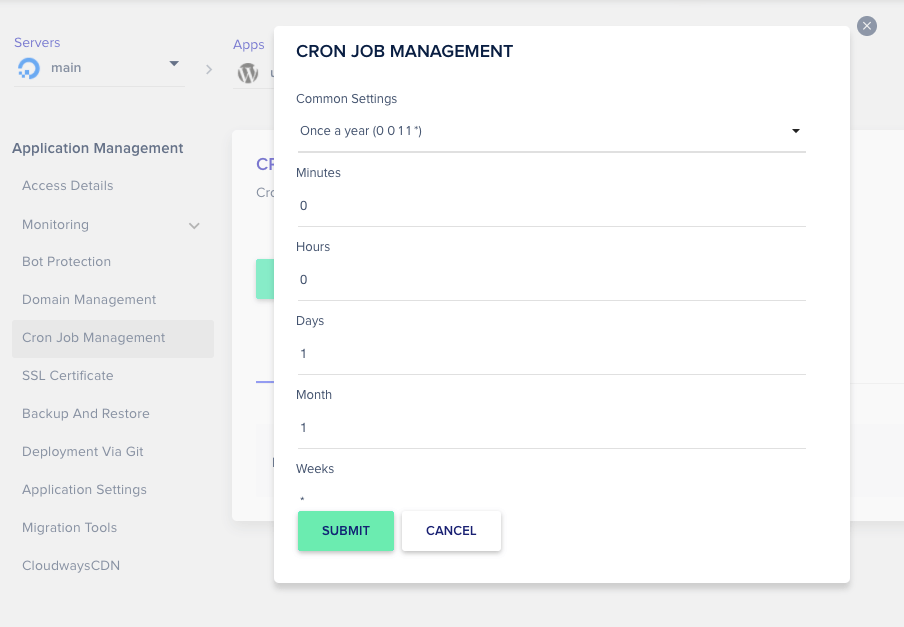
These settings will avoid the unnecessary execution of Linux commands in every page load, reducing the high CPU usage of WordPress during high-traffic conditions.
4. Integrate CDN for Content delivery
A CDN helps distribute your content across multiple servers worldwide. Instead of all users hitting your main server, static files are served from edge locations closer to users.
This reduces bandwidth usage, server requests and CPU load. Additionally, many CDNs offer bot protection and rate limiting, which further reduce unnecessary load.
If you use Cloudways hosting, here is a detailed guide to integrate CDN into your website. There are other hosting providers that offer Cloudflare CDN in their plans.
5. Audit Your Plugins (Be Ruthless Here)
Plugins are essential! However, they are also the biggest source of inefficiency. Instead of focusing on the number of plugins, focus on their impact.
Some WordPress plugins:
- Run background tasks continuously
- Make external API requests
- Load scripts on every page
These behaviors increase CPU usage significantly. A practical approach is to temporarily disable plugins and monitor changes in CPU usage.
This helps you identify which plugin is causing the issue. From my experience, removing just one problematic plugin can sometimes cut CPU usage in half.
6. Use Caching the Right Way
Caching reduces the amount of work your server has to do. Without caching, every request forces WordPress to Load PHP, Query the database, and Render the page.
With caching, a static HTML version is served instantly. However, not all caching setups are equal. A complete setup should include:
- Page caching for frontend
- Browser caching for repeat visitors
- Compression to reduce file size
When configured correctly, caching can reduce CPU usage drastically, especially for content-heavy sites.
While page caching helps with frontend performance, it doesn’t solve backend inefficiencies. That’s where object caching comes in.
Redis stores the results of database queries in memory, so repeated queries don’t hit the database again. This reduces MySQL load and speeds up dynamic operations.
For example, on a WooCommerce site, product queries are repeated frequently. Without object caching, each query consumes CPU resources. With Redis, those results are reused instantly.
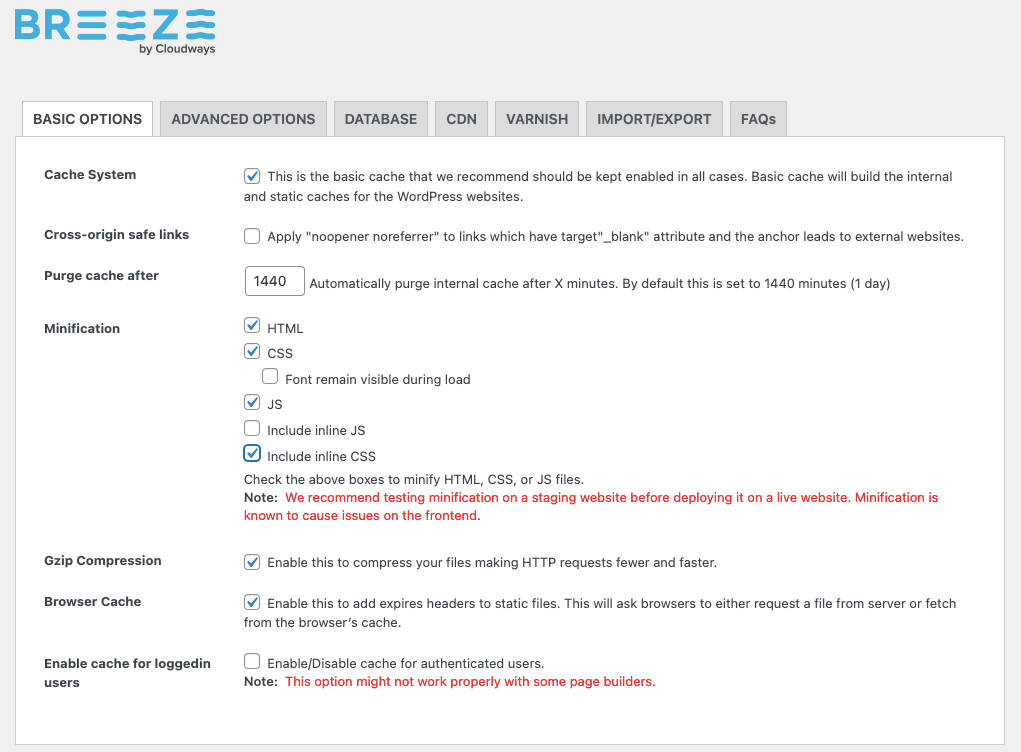
The Breeze WordPress cache plugin can reduce high CPU usage by internal caching operations, minification of scripts, and Gzip optimization in one place.
Its pre-installed varnish cache will decrease the page loading time with lesser database connection usage.
7. Reduce Background Activity in WordPress
WordPress runs multiple background processes that can add up over time. One example is the Heartbeat API, which sends periodic AJAX requests to keep sessions active and autosave content.
While useful, it can generate frequent server requests, especially in the admin dashboard. By limiting its frequency, you reduce unnecessary CPU usage without affecting functionality.
8. Block Unwanted Bots And Unwanted Traffic
Many site owners underestimate how much bot traffic affects performance. Bots don’t behave like real users.
They:
- Send repeated requests
- Target sensitive endpoints
- Ignore caching
This forces your server to process unnecessary requests, increasing CPU load. In several cases I’ve worked on blocking bots reduced CPU usage more than any caching optimization.
Using a firewall or CDN helps filter out malicious traffic before it reaches your server. You can also block specific endpoints like xmlrpc.php if not needed.
Wrapping it up
Reducing high CPU usage in WordPress isn’t about applying random fixes! it’s about understanding how your site uses server resources and optimizing each layer.
From my experience, the biggest improvements usually come from a combination of small changes like fixing WP-Cron, enabling caching, cleaning the database, and blocking bad traffic.
Once these are in place to reduce CPU usage in WordPress, your site becomes not just faster, but also more stable and scalable.
Start with the steps in this guide and monitor the results carefully. If you want a deeper analysis, I can help you identify exactly what’s causing the issue on your site and how to fix it efficiently.




Hi Sakthi,
It was an amazing article! I have been struggling with this for some time, and you share a lot of relevant information about why it happens and how can I minimize it. Thanks a lot for sharing such an in-depth resource. The process and solutions sound simple to follow, and I will be trying them out very soon. I appreciate you putting together this article, it has been a major help, and I will share it within my network to help others as well.
Love it, man! This article got my score way up from where it started. Countless ideas to get your speed up! Thank you.